Predictive scoring tools for website visitors fall into five practical categories: marketing automation platforms with native scoring (HubSpot, Marketo Engage, Salesforce Marketing Cloud Account Engagement, Salesloft), B2B account intent platforms (6sense, Demandbase, Bombora, ZoomInfo, Warmly), standalone predictive lead scoring engines (MadKudu, Breadcrumbs), product-led growth scoring tools (Pocus, Endgame, Correlated), and AI-powered website personalization platforms with built-in intent prediction (Pathmonk, Dynamic Yield, Intellimize). Each category optimizes for a different decision: lead routing, account prioritization, sales plays, PLG expansion, or real-time on-site experience.
For anonymous website visitors specifically, only two of those categories score likelihood to convert during the session, before a form fill: account intent platforms (which require a reverse-IP match to a known company) and AI-powered website engines (which score behavioral signals directly, without identification). Everything else scores leads post-capture, not visitors in real time. That distinction determines which tool is the right answer for your use case.
Table of Contents
A 2023 academic review of lead scoring models concluded that traditional rules-based models have no statistically significant impact on sales performance, while predictive models based on machine learning do. That finding is now roughly a decade old in the literature, but most marketing teams still run scoring systems that would be classified as traditional: static point assignments, linear thresholds, and fit attributes layered onto engagement counts.
The gap between what scoring models do and what marketers think they do has widened because the category has split. There is no single tool that handles “predictive scoring of website visitors.” There are five different tool categories that each solve a different slice of the problem, and most teams end up using two or three in parallel without a clear model of what each one actually predicts. The broader predictive analytics software category has been accelerating business performance for years, but website visitor scoring specifically remains fragmented because no vendor has bridged real-time session decisioning with long-horizon account scoring in the same product.
This piece maps the categories against a working framework, The Prediction Stack, walks through the evaluation criteria that actually matter (precision at k, calibration, lift vs. a holdout), and documents where predictive scoring reliably fails. It is written for operators who already know the difference between MQL and SQL scoring and are trying to decide whether to expand their stack, consolidate it, or replace a piece of it.
Get your website’s conversion score in minutes
- Instant CRO performance score
- Friction and intent issues detected automatically
- Free report with clear next steps
What “predictive” actually means in visitor scoring
A scoring model is predictive only if it answers a forward-looking question: given what this visitor has done so far, what is the probability they will convert within some defined horizon? Everything else is descriptive scoring dressed up in predictive language.
Three properties separate predictive models from rule-based ones.
First, the output is a probability or ranked percentile, not a point total mapped to a tier. A predictive score of 0.72 means the model estimates a 72% chance of conversion within the target window; a score of 280 points mapped to “hot lead” means nothing outside the tool that created it.
Second, the model learns from outcomes. Weights are set by fitting against historical conversion data, not by a marketer deciding that a pricing page view is worth 15 points. When the funnel changes, a predictive model recalibrates against new outcomes; a rule-based model keeps firing whatever weights someone wrote down six quarters ago.
Third, the horizon is explicit. A visitor score can predict conversion in the current session, within seven days, or over a 90-day window. Tools that collapse all three into one number are less useful than tools that expose the horizon, because acquisition decisions (should we pay to bring this visitor back?) and activation decisions (should we show them a demo offer right now?) depend on different horizons.
Website visitor scoring is strictly harder than lead scoring because the feature set is thinner. A lead has a form submission, a company, a role, and an email domain. An anonymous visitor has page sequences, time on page, scroll depth, referrer, device, and whatever first-party behavioral signals the site captures. The model has to produce a meaningful ranking from a noisier substrate, often within the first 60 seconds of a session. The underlying field is mature: predictive lead scoring as a discipline has been productized for more than a decade, but applying it to anonymous sessions rather than resolved leads is a harder problem that compresses the horizon from weeks to seconds.
The five tool categories that score conversion likelihood
The market is usually described as one category (“predictive lead scoring”) but operates as five, with different data inputs, latency profiles, and points of integration. Roughly 75% of high-growth B2B companies have adopted AI-powered lead scoring in some form, but adoption is spread unevenly across these five categories and most teams are running at least two. For teams shortlisting vendors alongside other optimization tooling, how predictive scoring fits into the broader CRO software landscape matters because the scoring tool is usually purchased as part of a stack, not in isolation.
Marketing automation native scoring
HubSpot predictive lead scoring, Marketo Engage’s Predictive Content and behavior scoring, Salesforce Marketing Cloud Account Engagement (formerly Pardot), and Salesloft’s scoring all sit in this bucket. These tools score known leads in your CRM or MAP. They use form fills, email engagement, known firmographics, and on-site behavior tied to a cookie or resolved contact.
They are useful for what they are built for: prioritizing the leads your sales team already has. They are not useful for scoring anonymous website visitors, because the score exists only once an identity has been resolved. By the time the scoring fires, the session the model was supposed to predict is already over. The conceptual distinction between lead qualification and lead scoring matters here because MAP native scoring is fundamentally a post-qualification prioritization tool, not a pre-identification decisioning tool. Teams evaluating MAP scoring against dedicated qualification workflows will find that the established lead qualification tools address a different part of the funnel entirely.
B2B account intent platforms
6sense, Demandbase, Bombora, ZoomInfo, and newer entrants like Warmly, RB2B, and Clearbit (now HubSpot Breeze Intelligence) operate at the account level, not the visitor level. They reverse-resolve anonymous website traffic to a company via IP, fingerprinting, or third-party cookie graphs, then score the company’s aggregated intent based on internal site behavior plus external signals (content consumption across the Bombora or G2 data network, ad engagement, research behavior on third-party properties). The underlying concept of intent data and how it is used to drive revenue is what this entire category is built on.
These tools predict which accounts are in-market, not which individual visitors will convert. The output is a prioritized list of target accounts with intent topics attached. A scored account does not tell you what to show the visitor now; it tells your SDR team who to call tomorrow. For operators who run ABM programs, that is exactly the right output; for operators who want to change the on-site experience based on real-time intent, it is the wrong one. This is why intent data platforms and traditional lead generation tools deliver different ROI depending on the question you are trying to answer, and why how to use intent data to generate more leads is a separate methodology from how to personalize in real time.
Account intent also has a structural ceiling: it only works for traffic that resolves to a known company. Consumer traffic, traffic from residential IPs, and traffic from companies outside the data provider’s coverage are effectively invisible. For teams weighing vendors, the established intent data providers and tools each sit on different coverage networks, so resolution rate is worth benchmarking against your specific traffic mix before signing.
Standalone predictive lead scoring engines
MadKudu and Breadcrumbs are the two most visible examples. These tools specialize in fitting a predictive model on your conversion history and piping the score into your MAP or CRM. They tend to be stronger than the native scoring inside HubSpot or Marketo because scoring is their entire product, not a checkbox feature.
They work best for teams that already have a meaningful conversion dataset (hundreds of positive outcomes per quarter minimum) and want a score that reflects the actual shape of their funnel rather than a generic template. They do not score anonymous traffic in real time during the session. They score leads, free trials, and accounts, and they feed the score into downstream systems where the score gets acted on later. The underlying approach is well-documented: predictive analytics for anticipating customer behavior with AI has been a stable academic and commercial domain for years, which is why these standalone tools can usually outperform a MAP’s checkbox feature.
Product-led growth scoring
Pocus, Endgame, and Correlated are the PLG-native category. They combine product usage events with CRM and marketing data to score free-trial or free-tier accounts on likelihood to convert to paid or expand. This is the category closest to “predictive conversion scoring” for SaaS, but the signal set is product usage, not website behavior. If your conversion event is the paid upgrade of a free user, these tools are the right answer. If your conversion event is a website form submission or a demo booking from a first-time visitor, they are not. The PLG category is purpose-built for the specific problem of converting SaaS free-trial users into paying customers, which is a post-signup prediction problem, not a pre-signup one.
AI-powered website personalization engines
Pathmonk, Mutiny, Dynamic Yield, Intellimize, and Optimizely’s personalization product sit in this bucket. These tools score anonymous visitors in real time based on behavioral signals during the session, then act on the score by changing what the visitor sees. The score exists for a practical reason: to decide which experience, offer, or microexperience to serve. Because the score must be produced fast enough to personalize the page, the models are lighter and the prediction horizon is typically the current session or the next 24 hours. The signal set is entirely first-party behavioral data captured on the site, which is what makes these tools viable in a cookieless environment. Teams that want to go deeper on the signal side will find that customer behavior data analysis reveals patterns that can directly feed a scoring model.
How each category models “likelihood to convert”
The five categories differ less in their mathematical sophistication than in what they are willing to predict and how fast. A comparison makes the trade-offs concrete.
Category | Input signals | Prediction horizon | Latency | Strongest when |
MAP native scoring | Form data, email opens, cookie-linked behavior | Days to weeks | Post-conversion | You already have the lead and want to rank it |
Account intent | Reverse-IP traffic + third-party research behavior | Days to quarters | Hourly to daily batch | You run ABM with a defined target account list |
Standalone predictive scoring | Full CRM + MAP history | Days to weeks | Post-conversion | You have ≥ 500 conversions in history and a bad native score |
PLG scoring | Product usage events + CRM | Weeks | Daily batch | Your conversion event is an in-product upgrade |
Website AI engines | On-site behavior, referrer, device, sequence | Current session to 24h | Sub-second | You want to change what the visitor sees now |
The table makes the core point: no single tool covers the whole range. Teams that want both a long-horizon account score and a real-time visitor score are running an account intent tool alongside a website AI engine. Teams that try to solve the real-time-on-site problem with their MAP’s native scoring end up reacting to every session after it has already ended.
The Prediction Stack: how to evaluate any visitor scoring tool
Evaluating a predictive scoring tool requires looking at four layers, not one. Vendors tend to pitch whichever layer they are strongest on and gloss the other three. Calling this the Prediction Stack helps keep the comparison honest.
Layer 1: Signal capture. What behaviors does the tool track? Pageviews and sessions are the floor, not the ceiling. Serious tools capture scroll depth, time-on-element, sequence (not just set) of page visits, referrer grain finer than “organic,” recurrence across sessions, and device-level continuity across visits. A model trained on weak features cannot become strong with a better algorithm.
Layer 2: Model. What function turns the signals into a score? Ask three questions. What is the target variable (conversion in session? booking in 7 days? purchase in 30 days?). How often is the model retrained (daily, weekly, never)? What is the training sample size and is it specific to your site or a generic template applied at onboarding? A scoring model trained on the vendor’s aggregate customer base will generalize poorly to a niche B2B site with a long buying cycle.
Layer 3: Decisioning. What does the tool do with the score once it exists? A score that does not drive a decision is analytics, not scoring. Decisioning layers differ dramatically across categories: MAP scoring drives lead assignment rules, account intent drives SDR prioritization, website AI engines drive microexperience selection. Ask what decisions the score is wired into by default and what it takes to wire it into a new one.
Layer 4: Activation. Where does the output flow? Native CRM fields, webhook, reverse ETL, on-page render? Activation gates whether the score creates real business outcomes or sits in a dashboard. The highest-precision score in the world is worth zero if your team cannot act on it inside the buying window.
Most evaluations focus on Layer 2 (the model) because that is what vendors market. In practice, Layer 3 and Layer 4 are where tools win or lose deployments. Coverage at the tool-selection level matters more than algorithmic sophistication when picking CRO tools. The newer class of AI agents built for marketing workflows is starting to collapse layers 3 and 4 into a single autonomous loop, which is worth tracking as a future-state architecture.
Metrics that actually validate a predictive scoring model
The metric every vendor shows is accuracy. Accuracy is close to useless for conversion scoring because the positive class is rare: if 2% of sessions convert, a model that predicts “no conversion” for every visitor is 98% accurate and completely worthless.
The metrics that matter:
Precision at k. Among the top k% of scored visitors, what percentage actually convert? For real-time personalization, precision at the top 10% and top 20% are the numbers to stress-test. A model with 40% precision at top 10% is doing real work; one at 6% precision at top 10% is performing only slightly better than random on a 2% base rate.
by score
Calibration. When the model says 0.8 probability, does the actual conversion rate for that bucket approximate 80%? Uncalibrated models can rank correctly but report wildly wrong probabilities, which breaks any downstream decisioning that uses the probability as an input (bid caps, budget allocation, CTA selection). Calibration matters most when the score gets used outside the scoring tool itself, which is why journey analytics tools that consume the score downstream expose calibration errors before they show up in the scoring dashboard.
Lift against a holdout. What is the conversion rate of the group exposed to score-driven decisioning versus a randomly held-out control? Lift is the only metric that survives contact with the business: it is what actually shows up in the revenue number. If a vendor cannot produce a lift figure against a contemporaneous control group, the deployment has not been validated. Pathmonk’s approach to measuring conversion uplift uses a 50/50 A/B split against a preserved 5% control group for exactly this reason.
Stability over time. Conversion patterns drift. A model that was strong in Q1 may be weak in Q3 because traffic mix, product, or messaging changed. Ask how often the vendor retrains and whether they expose model performance metrics over time. Agentic approaches to CRO are increasingly able to self-recalibrate as the funnel shifts, but most tools still require manual retraining or quarterly review.
The 2×2 confusion matrix at the threshold you actually operate at. Pick the score threshold you would use to trigger an action. Count true positives, false positives, true negatives, false negatives. Compute the cost of each. A false positive that serves a demo CTA to a visitor who was never going to convert is cheap. A false positive that triggers an outbound SDR call on an uninterested prospect is not.
Where predictive visitor scoring reliably fails
Every vendor in every category describes their tool as universally applicable. It is not. Five situations where predictive visitor scoring breaks.
- Low traffic. Predictive models need conversion events to learn from. Sites with fewer than roughly 10,000 monthly sessions and fewer than 100 conversions per month will produce unstable scores regardless of vendor. The model has nothing to fit against. Below these thresholds, rule-based approaches to CRO with low traffic will often outperform predictive scoring simply because they are not pretending to have data they do not have.
- Cold start. Freshly deployed tools take weeks to produce useful scores. Some vendors hide this by applying a generic template model during the training window; the scores look fine, but they are not fit to your site. Ask explicitly what the tool does between day 1 and first calibration, and budget for the training period in launch plans.
- Drift. A redesign, a new product line, a price change, or a seasonality shift invalidates a trained model. The score will continue to fire and continue to look authoritative while quietly drifting out of calibration. If a vendor does not expose drift metrics or a drift alert, assume the model is drifting and plan for manual review every quarter.
- Overweighting one signal. Models that lean heavily on a single feature (usually pageviews to the pricing page) produce scores that are easy to game and easy to break. A competitor with a Puppeteer bot can pump every visitor’s score to the top. Robust models weight a diverse signal set and degrade gracefully when any one feature is missing.
- Misalignment between scored event and business outcome. If your model scores “form submission” but revenue comes from “demo-to-close,” your score is predicting the wrong thing. Most visitor scoring tools score the first tracked event rather than the deepest one in the funnel. This produces local wins (more form fills) that do not translate to pipeline. Paid lead generation creates this problem at scale when volume-optimized scoring decouples from qualified-buyer outcomes, and only 27% of marketing-sourced leads sent to sales are actually qualified for sales engagement in the first place.
How Pathmonk scores visitor intent and acts on it during the session
Pathmonk sits in the fifth category: AI-powered website personalization with built-in, session-level intent scoring. The product exists because the other four categories do not solve the real-time visitor decision. Account intent platforms tell you the company of the visitor the next day; MAP scoring tells you the lead quality after they have converted; PLG scoring tells you which free users will upgrade. None of them answer what to show the anonymous visitor on page 2 of their first session.
The scoring pipeline has four mechanical stages.
- First, a cookieless behavioral fingerprinting layer captures pageview sequences, scroll depth, dwell times, referrer, device, and cross-session recurrence without dropping third-party cookies and without requiring consent banners.
- Second, an intent classification model places the visitor into one of three buying journey stages (awareness, consideration, decision) based on the behavioral signal pattern. Pathmonk’s stage detection uses page sequence, time, and interaction depth rather than fixed point rules, so the classification updates as the session develops.
- Third, a decisioning layer selects a microexperience appropriate to the current stage: awareness-stage visitors see social proof or educational framing, consideration-stage visitors see product comparison or ROI content, decision-stage visitors see the conversion-goal CTA. Microexperiences are small AI-powered interactions that adapt to each visitor’s intent in real time and are rendered inline on the existing site without a redesign.
- Fourth, an automated experimentation loop runs a 50/50 split of exposed vs. control traffic, measures statistical significance at 95% confidence against a preserved control group, and reports lift directly against the conversion goal.
The scoring is only the first half of the product; the activation layer is what turns the score into a measurable business outcome, which is where most scoring deployments in the other four categories stall. The score drives a different on-page experience for every visitor in the same session the score is computed, with no dev work on the customer side and no cookies.
This is structurally compatible with the cookieless future that is already reshaping buying journeys and personalization because the scoring pipeline never relied on third-party cookies in the first place. For B2B teams that also want account-level resolution, the company identification add-on surfaces which businesses are visiting and at what intent level, pushing verified accounts to CRM via Zapier or native integrations.
For teams comparing tool categories, the tradeoff Pathmonk makes is explicit: narrower prediction horizon (session-level, not quarterly), but sub-second latency and automatic activation into the on-page experience.
How Auditoria tripled conversions by matching asks to intent stage
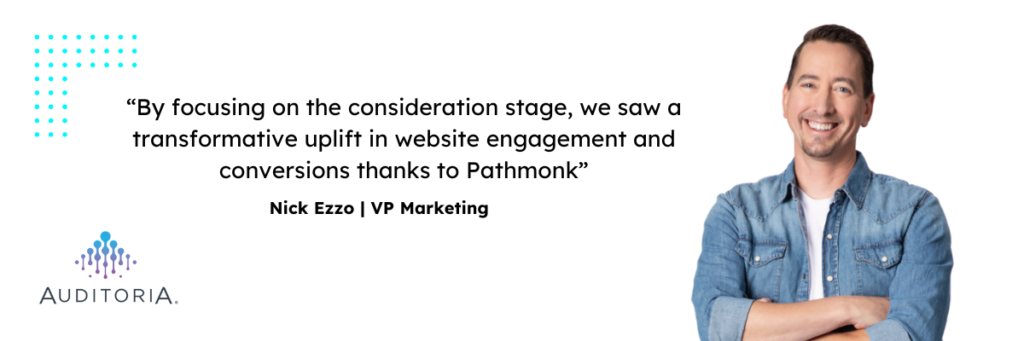
Auditoria.AI builds an AI-powered finance automation platform for accounts payable and accounts receivable teams, competing in a SaaS category where buyer education is long and website visitors typically research across multiple sessions before taking an action. Nick Ezzo, leading marketing, was responsible for improving website conversion from a pool of relevant but cautious technical buyers.
Despite strong page view volume, the site’s conversion rate was stuck. Diagnostic work pointed to the core mismatch: conversion goals were set to push every visitor toward the same high-commitment action, regardless of where that visitor actually was in their buying journey. Visitors in an earlier research stage were being asked to book a demo and disengaging; visitors in a decision stage were being given generic educational content instead of a direct path to convert. The problem was not insufficient traffic or weak CTAs; it was that every visitor saw the same CTA no matter what their behavior on the site implied about their readiness.
Auditoria deployed Pathmonk as the session-level intent classification and activation layer. The system read behavioral signals (page sequences, time on page, scroll depth, recurrence) in real time, placed each visitor into awareness, consideration, or decision stage, then served a matching microexperience. Consideration-stage visitors received product explainers, FAQs, expert content and customer testimonials. Decision-stage visitors received a direct conversion CTA. The existing website content was repurposed into stage-matched microexperiences rather than rewritten, which shortened the implementation window considerably.
Conversion rate increased by +300%, effectively tripling the number of website visitors who converted. Session engagement improved in parallel, and no new content had to be produced to achieve the lift: existing marketing assets were surfaced at the right stage instead of being buried behind navigation.
Get more conversions from your organic traffic
Maximize SEO results by turning high-intent organic visitors into leads and customers, even as Google updates and AI search change the rules.
Book a demo
FAQs on predictive scoring
What is the difference between predictive lead scoring and predictive visitor scoring?
Predictive lead scoring ranks known leads already in a CRM or MAP based on their likelihood to convert to the next funnel stage. Predictive visitor scoring ranks anonymous sessions in real time based on behavioral signals captured on-site. The two use overlapping techniques but solve different problems: lead scoring informs sales prioritization after identification; visitor scoring informs on-site personalization before identification.
Can HubSpot or Marketo score anonymous website visitors?
Not in a useful way. HubSpot predictive lead scoring and Marketo’s scoring features operate on known contacts with a resolved identity. They can score sessions from contacts who are already in the database and cookied, but they cannot score first-time anonymous visitors during the session. For real-time scoring of anonymous traffic, you need either an account intent platform or a website AI engine.
How much traffic do you need for predictive scoring to work?
Most predictive models need on the order of 10,000 monthly sessions and 100 conversion events per month as a minimum. Below that, the model has too few positives to learn from and scores become unstable. Pathmonk’s documented threshold is 10,000 pageviews per month; other vendors require more. Whether CRO is worth the investment depends partly on whether your traffic volume supports a trained model, and conversion rate benchmarks by industry give a useful reference point for estimating how many positive events your traffic should produce.
How is predictive visitor scoring different from intent data?
Intent data usually refers to third-party behavioral data aggregated across a network of sites (Bombora, G2, TrustRadius). It tells you whether an account is researching a topic across the wider web. Predictive visitor scoring uses first-party behavioral data from your own site. The two are complementary: intent data informs account prioritization; visitor scoring informs on-site response. The power of intent data marketing depends on how it is paired with first-party behavioral signals, and intent data platforms and traditional lead generation tools answer different questions that should not be evaluated against the same ROI metric.
Does GA4 do predictive visitor scoring?
GA4 produces two predictive metrics, Purchase Probability and Churn Probability, using the Analytics Intelligence model. They work for e-commerce properties that meet Google’s data volume requirements (1,000 returning users with positive and negative events in the last 28 days). The metrics are usable for audience building inside Google Ads but they are not exposed with the latency or decisioning API required for real-time on-page personalization. For most practical purposes, GA4 predictive metrics are a reporting artifact rather than an activation layer, and teams that need real-time decisioning run a separate tool alongside.
How do you validate a vendor’s scoring accuracy claim?
Ask for precision at the top 10% and top 20% of scored traffic, measured against your own conversion data after a minimum two-week training window. Ask for lift against a randomly held-out control group, not a month-over-month comparison. Ignore accuracy as a metric. If a vendor cannot produce precision at k and lift against holdout, assume they have not validated their model against your funnel.
Can predictive visitor scoring replace A/B testing?
No. Predictive scoring selects which experience to serve; A/B testing measures whether the score-driven selection produces lift against a control. The two are complements. Responsible deployments of visitor scoring always preserve a control group so that the lift from score-driven personalization is measurable. Teams that turn off the control to “fully deploy” the model lose the ability to tell whether the model is still working.
Is predictive visitor scoring compatible with cookie consent regulations?
It depends on the signal set. Tools that rely on third-party cookies or persistent identifiers typically need consent. Tools that use cookieless behavioral fingerprinting with first-party data can usually operate under legitimate interest without a consent banner, subject to jurisdictional review. Real-time personalization in a cookieless environment is technically possible but changes the data-capture architecture.
When does it make sense to use two or more predictive scoring tools in parallel?
When your decisions span different horizons and scopes. A common stack: account intent platform for SDR prioritization (account, daily), website AI engine for on-page personalization (visitor, session), MAP native scoring for lead routing (contact, post-capture). Overlap is acceptable because the scores drive different actions. Redundancy is a problem only when two tools are wired into the same decision and produce conflicting recommendations. The account intent side and the visitor scoring side solve different sub-problems: account intent prioritizes outreach, while visitor scoring decides what to do with visitors who are not yet ready to book a call.
Key takeaways
- Predictive scoring of website visitors is handled by five distinct tool categories, not one: marketing automation native scoring, B2B account intent platforms, standalone predictive scoring engines, PLG scoring tools, and AI-powered website personalization engines.
- Only two of the five categories score anonymous visitors in real time during the session: account intent (account-level, resolved via reverse-IP) and website AI engines (visitor-level, based on behavioral signals).
- A model is predictive only if its output is a probability, its weights are fit against outcomes, and its prediction horizon is explicit. Point-based rule systems are not predictive regardless of how they are marketed.
- Evaluate any scoring tool on all four layers of The Prediction Stack: signal capture, model, decisioning, and activation. Most failed deployments fail at layers three and four, not at the model.
- Accuracy is close to useless for conversion scoring because positive classes are rare. Use precision at k, calibration, and lift against a contemporaneous control group.
- Predictive scoring reliably fails under low traffic (< ~10,000 monthly sessions), cold start, model drift, single-signal overweighting, and misalignment between the scored event and the business outcome that matters.
- Website AI engines like Pathmonk score session-level intent and use the score to select a microexperience in real time, collapsing the prediction and activation steps into a single sub-second operation against a preserved control group.
- No single tool covers the full prediction horizon. Teams that want both account-level quarterly intent and session-level real-time activation run two tools in parallel.