The most effective CRO tools for B2B SaaS fall into five functional categories: session analytics, intent data and company identification, behavioral personalization, A/B and multivariate testing, and lead capture with qualification routing. No single tool covers all five adequately, and the tools that dominate e-commerce CRO (cart abandonment platforms, broad pop-up builders) consistently underperform in SaaS contexts where the conversion goal is a demo, trial, or sales conversation rather than a purchase.
The selection criteria for B2B SaaS differ from e-commerce in three specific ways: longer buyer cycles require tools that track intent across multiple sessions rather than within a single visit; anonymous company identification matters more than individual contact enrichment at the top of the funnel; and form-based lead capture needs to work alongside or be replaced by lower-friction qualification mechanisms. The tools evaluated in this article are assessed against those criteria, not against generic CRO benchmarks.
Table of Contents
A 2023 benchmark report from Wynter found that the median B2B SaaS website converts at 2.3% for trial signups and 0.9% for demo requests, with the top quartile achieving 4.1% and 2.2% respectively. You can cross-reference these numbers against industry-specific conversion rate benchmarks to understand where your funnel sits relative to sector peers. The gap between median and top-quartile performance is not primarily explained by design quality or copywriting. It correlates with how systematically companies instrument their site, identify high-intent visitors, and intervene at the right moment in the buying process.
The CRO tool market has fragmented significantly since 2020. There are now over 400 tools that describe themselves as “conversion optimization” software, most built for e-commerce or general lead generation rather than for the specific mechanics of B2B SaaS funnels. The result is that SaaS marketing teams frequently adopt tools that generate data without generating decisions, or that optimize individual page elements without accounting for the multi-touch, multi-session reality of B2B buying. Before investing in tooling, it is worth asking whether CRO is even worth it for your current traffic level and what ROI to realistically expect.
This article maps the five functional categories that drive measurable conversion improvement in B2B SaaS, names specific tools within each, identifies where each category fails, and explains how to sequence the stack without creating data conflicts. The organizing framework is called the Conversion Signal Stack, reflecting that B2B SaaS conversion depends on capturing the right behavioral signals at each stage of a long and often anonymous buying journey.
Get your website’s conversion score in minutes
- Instant CRO performance score
- Friction and intent issues detected automatically
- Free report with clear next steps
Why B2B SaaS CRO is structurally different
B2B SaaS buying cycles average 27 days for SMB and over 90 days for mid-market, according to Gartner’s 2023 B2B Buying Report. During that window, the same individual or buying committee returns to a website multiple times across different devices and sessions. Research into B2B customer journey touchpoints consistently shows that most deals involve five or more website visits before a form is submitted. Standard CRO tools that optimize for single-session interactions miss the majority of the decision process.
The core technical constraint is session isolation: most CRO platforms treat each visit as independent, which breaks personalization logic for visitors who have already expressed intent on a previous session.
Three other structural differences compound this. First, traffic volume in B2B SaaS is lower than in e-commerce. A site with 10,000 monthly visitors at a 2% conversion rate produces 200 conversions per month. A/B tests requiring 95% statistical confidence take 6 to 10 weeks to read at this volume, compared to 5 to 7 days for an equivalent e-commerce site. Tools that require high traffic volume for reliable results are structurally mismatched with most SaaS use cases.
Second, the conversion event in B2B SaaS is rarely transactional. It is a form fill, a trial signup, or a calendar booking. The primary optimization opportunity is not in a checkout flow but in the content pages, pricing page, and resource sections that precede the conversion action. Understanding why a conversion rate might be low requires separating traffic quality problems from on-site friction problems, and these require different tools to diagnose.
Third, company firmographics change the relevance of every page element. A visitor from a 50-person startup evaluating your product has fundamentally different needs than a visitor from a 5,000-person enterprise, even if their on-site click behavior looks identical. Tools that cannot segment or personalize by company size or industry miss the most actionable signal in B2B.
The Conversion Signal Stack: five layers
The Conversion Signal Stack organizes CRO tools into five layers based on the type of signal they capture and the intervention they enable. Each layer is necessary; none is sufficient alone. For a broader view of CRO best practices and where tooling fits into the overall optimization process, this framework gives you a concrete sequence to follow.
Layer | Signal type | Primary output |
1. Session intelligence | Behavioral: clicks, scroll, rage clicks | Diagnosis |
2. Intent and company identification | Firmographic + behavioral patterns | Prioritization |
3. Personalization and targeting | Segment + behavior combined | Content adaptation |
4. Experimentation | Statistical comparison of variants | Validated changes |
5. Lead capture and qualification | Form data + routing logic | Pipeline |
Layers 1 and 2 are diagnostic; layers 3, 4, and 5 are interventional. Skipping directly to personalization or testing without a diagnostic foundation produces optimization theater: changes that improve metrics on individual elements without addressing the actual friction points in the funnel.
Layer 1: session intelligence tools
Session intelligence covers heatmaps, session recordings, and behavioral analytics. The primary use case is diagnosis: identifying where visitors drop off, where they encounter friction, and which page elements generate engagement versus confusion. Most frustrated website users leave signals that only session-level data can surface.
Hotjar and Microsoft Clarity are the most commonly deployed tools in this category, but their utility in B2B SaaS is constrained by the same limitation: neither segments sessions by firmographic data, so recordings from a decision-ready enterprise buyer look identical to sessions from a student researching a term paper.
Hotjar’s form analytics are its highest-leverage feature for SaaS teams. For sites where a demo request form is the primary conversion mechanism, field-level abandonment tracking identifies which specific questions cause drop-off. Recurring findings: company size fields reduce completion by 15 to 22%; phone number fields reduce completion by 30 to 40%. Both are addressable in under two weeks.
Microsoft Clarity is free and captures 100% of sessions, whereas Hotjar’s free tier is capped by session volume. For sites under 30,000 monthly sessions, Clarity is sufficient for recording analysis. Its AI-generated session summaries, introduced in 2023, reduce time-to-insight for teams without a dedicated CRO analyst.
FullStory occupies the premium end and justifies its cost through one specific capability: CRM data layer integration that allows filtering session recordings by deal size, customer tier, or lead score. Seeing how a $100K ARR prospect navigates your pricing page is materially different from watching a cold organic visitor do the same. This segmentation is the primary reason enterprise SaaS teams pay 10 to 20 times Hotjar’s price. You can cross-reference session tools against a broader marketing analytics tool comparison to understand how they fit into your wider data stack.
Where the category fails: session intelligence tells you what happened, not why. A 70% drop-off rate on a pricing page indicates a problem; it does not tell you whether the problem is pricing structure, missing social proof, or ambiguous positioning. Session data requires pairing with qualitative research (user interviews, on-site surveys) to generate hypotheses worth testing. The CRO testing process only becomes productive once you have specific, evidence-backed hypotheses to run.
Layer 2: intent data and company identification
This is the highest-leverage layer in the Conversion Signal Stack for B2B SaaS and the most underinvested. Intent data tools identify which companies are visiting your site, what they are researching, and how close they are to a buying decision. Combined with third-party intent signals, they allow marketing and sales teams to prioritize outreach before any form is submitted. A detailed comparison of intent data platforms vs. traditional lead generation tools shows the ROI difference is particularly pronounced for sales-assisted motions.
Clearbit Reveal (now Breeze Intelligence following HubSpot’s acquisition) identifies the company behind anonymous website traffic using IP-to-company matching. Match rates vary: 50 to 65% for US traffic, lower internationally. The output enables real-time content or CTA adaptation based on company size, industry, or CRM status, without requiring a visitor to self-identify. Pathmonk’s own guide on how to identify companies visiting your B2B website covers how to layer this kind of identification into a personalization workflow.
6sense and Demandbase operate differently. They aggregate third-party intent signals from across the web (G2, TechTarget, content syndication networks, partner platforms) and combine them with first-party behavioral data. A prospect researching your product category across five different platforms in the same week shows purchase intent even if they have not yet visited your site. This signal is fundamentally different from on-site behavioral data and is most valuable for triggering outbound sequences 30 to 60 days before a prospect’s active evaluation window.
The practical limitation of third-party intent platforms is organizational readiness: they are only as valuable as the sales and marketing alignment that allows teams to act on signals within days rather than weeks.
Leadfeeder (now Dealfront) occupies a mid-market position between Clearbit’s on-site focus and 6sense’s full-funnel scope. It identifies companies visiting your site, scores them by engagement depth, and pushes records to your CRM with visit history attached. For SaaS companies generating under 50 demo requests per month, Leadfeeder’s pricing and simplicity are more appropriate than enterprise intent platforms.
RB2B is a newer entrant that identifies individual LinkedIn profiles behind anonymous US traffic and pushes them directly to Slack. Individual-level identification is more actionable than company-level for SDR-led outreach, but it is restricted to US traffic and requires data handling review in regulated industries and EU markets. For teams beginning to build predictive lead scoring into their workflow, company identification is the necessary first step before behavioral scoring adds value.
For teams below $10M ARR without a dedicated revenue operations function, company identification via Clearbit or Leadfeeder is the right starting point. Third-party intent platforms require data maturity and cross-functional coordination to extract value from and will sit unused without both.
Layer 3: personalization and behavioral targeting
Personalization tools use signals from layers 1 and 2 to serve different content, offers, or experiences to different visitors without running a formal statistical experiment. The underlying logic: if a visitor is from a mid-market financial services company in their second session, the homepage headline, the social proof shown, and the CTA timing should all reflect that context. How website personalization drives higher sales is well-documented; the gap between knowing this and executing it cleanly is where most teams stall.
The dominant approach among B2B SaaS personalization platforms is firmographic-based segmentation: serving different content to different company types based on IP-to-company data. The structural limitation of this approach is that it tells you who the visitor is, not where they are in the buying process. A first-time visitor from a Fortune 500 account and a returning visitor from that same account who has viewed your pricing page three times look identical to a firmographic system. They are not the same buyer at the same stage, and treating them identically wastes the most valuable conversion opportunities in your pipeline. Firmographic platforms also require a minimum of roughly 1,000 monthly visitors per segment to produce reliable decisions, which constrains them to well-trafficked audience segments and demands sustained content operations to keep each variant current.
Personalization produces the highest conversion lift when the primary source of friction is relevance mismatch rather than UX or page performance issues. If visitors are dropping off because navigation is confusing or pages load slowly, personalization adds no value. The diagnostic work from layer 1 must precede the personalization investment in layer 3. This is the core argument in any discussion of hyper-personalization as a marketing strategy: the signal quality has to be there before the personalization layer can work.
The most common failure mode in personalization is over-segmentation. Teams that build 20 or more audience segments before validating even five create a governance problem: content freshness, QA coverage, and performance attribution all degrade when segment count outpaces team capacity. The practical ceiling for a single marketing operations hire managing personalization is eight to twelve active segments. The better starting point for most B2B SaaS teams is behavioral intent classification: personalizing based on what stage the visitor is at rather than which company they work for. This is where Pathmonk’s approach differs materially from the firmographic model, and it is covered in detail in the Pathmonk section below.
A related but distinct tool category within layer 3 is behavioral trigger tools: platforms that display an overlay, chatbot prompt, or contextual offer based on real-time on-page signals such as time on page, scroll depth, or exit intent. Exit-intent strategies have evolved significantly beyond the generic pop-up, and research on whether exit-intent pop-ups are still effective for B2B SaaS consistently shows that trigger specificity matters more than trigger type. Chat-based qualification that triggers on pricing page visits consistently outperforms generic exit-intent overlays by 3 to 5x on demo conversion rate, per Drift’s 2022 Benchmark Report, because the trigger correlates with genuine buying intent rather than incidental navigation behavior. What to do with visitors who are not ready to book a call is a related decision point that behavioral trigger logic can address without losing the lead.
1–50 employees
51–500 employees
500+ employees
Layer 4: A/B testing and experimentation
A/B testing platforms allow you to validate whether a change improves conversion before rolling it out permanently. In B2B SaaS, the traffic constraint defines what is testable. Standard A/B tests require a minimum of 250 conversions per variant to reach 80% statistical power at 95% confidence. For a SaaS company generating 200 demo requests per month, a single rigorous test takes longer than most marketing teams sustain attention for. CRO innovations in AI-driven testing are beginning to address this constraint, but traffic volume remains the binding variable for the majority of teams.
VWO and Optimizely are the category leaders. VWO’s starting plans are accessible for mid-sized SaaS teams; Optimizely’s enterprise pricing is appropriate only for companies with sufficient traffic volume and a dedicated experimentation function (realistically, over 50,000 monthly sessions on the pages being tested). Pricing split testing is one of the higher-leverage experiments available to SaaS teams but requires the page traffic to support it statistically. Google Optimize was sunset in September 2023, pushing many SMB SaaS teams to evaluate alternatives. Convert and AB Tasty absorbed meaningful market share in that segment.
The most underused feature in A/B testing for SaaS is multipage testing: measuring whether a change on page A affects conversion on page B or C, one or two steps downstream. Optimizing individual elements (CTA button copy on the homepage) without measuring downstream pipeline impact produces local maxima that may not translate to revenue improvement.
For teams below the traffic threshold for reliable experiments, GrowthBook (open-source) provides server-side testing without platform cost. The trade-off is implementation overhead: GrowthBook requires engineering involvement that commercial platforms abstract away.
Where A/B testing fails as a program: when organizational culture does not support acting on flat results. A test showing no significant difference between variants is valid and valuable data. Teams that have not established the expectation that most tests will be inconclusive treat flat results as failures and abandon the program. Experimentation programs that run fewer than 10 completed tests per year rarely generate compounding learning.
Layer 5: lead capture and qualification
Lead capture tools convert on-site engagement into identifiable pipeline. The core function is the form, but in B2B SaaS, forms are progressively supplemented or replaced by multi-step qualification flows, AI chat, and product-led mechanics. Optimizing your lead generation landing pages is where this layer intersects most directly with content strategy, and the science behind high-converting landing pages applies directly to the forms and flows housed on them.
Typeform and Jotform enable multi-step progressive forms that reduce cognitive load at each step. Multi-step forms convert 10 to 14% better than single-page forms for demo requests in B2B contexts, per Unbounce’s 2023 Conversion Benchmark Report. The mechanism is completion momentum: visitors who answer the first two low-friction questions are significantly more likely to complete the form than those confronted with seven fields simultaneously. The practical design rule is to defer the most friction-generating fields (phone number, company size, budget range) to later steps. Balancing funnel simplicity against qualification depth is a genuine trade-off with no universal answer, and the right split depends on your average deal size and sales motion.
Chili Piper addresses a specific and measurable conversion gap: speed-to-lead. Studies consistently show that following up within five minutes of a form submission increases qualification rates by 21 to 35 times compared to follow-up at 30 minutes, per InsideSales.com data. Chili Piper routes leads to the right rep and books a meeting within the same session, collapsing the time between intent expression and sales conversation. Implementation requires CRM routing rules, calendar integration, and territory mapping, making it more appropriate for teams generating over 100 demo requests per month where the setup complexity is justified.
The lead quality problem in B2B SaaS is distinct from lead volume: most demand generation programs capture roughly three times more leads than sales can meaningfully work, but those leads are unevenly distributed across intent levels. Why paid lead generation brings volume but not qualified buyers is a problem that no form tool solves on its own. Qualification tools that route based on on-site behavioral signals rather than self-reported form field responses consistently produce better SQL rates because behavioral signals predict intent more reliably than job title or company size alone.
Qualified and Landbot represent the conversational qualification category. Both use chatbot flows triggered by behavioral signals to qualify visitors before routing them to sales. Qualified has deeper Salesforce integration and is better suited for enterprise sales motions where rep availability, territory logic, and real-time sales alerts are significant factors. Landbot offers more flexibility for custom flow building and works across a wider range of CRM environments. How to increase conversions with a qualification flow covers the mechanics of building these in practice.
How Pathmonk replaces the entire Conversion Signal Stack
The traditional build-out of the Conversion Signal Stack requires five separate platforms, five vendor contracts, five data integrations, and enough team bandwidth to operate and maintain all of them. Most B2B SaaS marketing teams do not have this. They end up with session data from one tool that cannot talk to the personalization layer, a personalization layer that has no view of what the experimentation platform is running, and a lead capture system that routes based on form fields rather than the intent signals the other tools have been collecting all along. The stack is theoretically complete but practically fragmented.
Pathmonk is designed to run all five layers through a single JavaScript snippet, with no developer work required beyond installation. Pathmonk for SaaS covers how this works in practice for the specific conversion challenges of SaaS websites, where fragmented journeys and one-size-fits-all CTAs are the two most common failure modes.
1. Behavioral analytics. Pathmonk’s analytics suite provides the diagnostic data that session intelligence tools supply elsewhere: full buying journey reports showing which stages visitors pass through and where they drop off, buyer persona segmentation based on behavioral signals, page-level performance data, and automatic bot traffic filtering to keep conversion metrics clean. The conversational analytics layer allows teams to query their own data directly. These reports do the diagnostic job of layer 1 without requiring a separate heatmap or recording tool.
2. Visitor identification and intent. Pathmonk uses cookieless fingerprinting to identify and track individual visitors across sessions without storing personally identifiable data. This solves the session isolation problem that breaks most CRO platforms in B2B contexts: Pathmonk recognizes a returning visitor on their fourth session and knows they previously spent time on the pricing page. The B2B Intent Leads add-on extends this to company-level identification, surfacing which organizations are on the site, their engagement depth, and their buying stage.
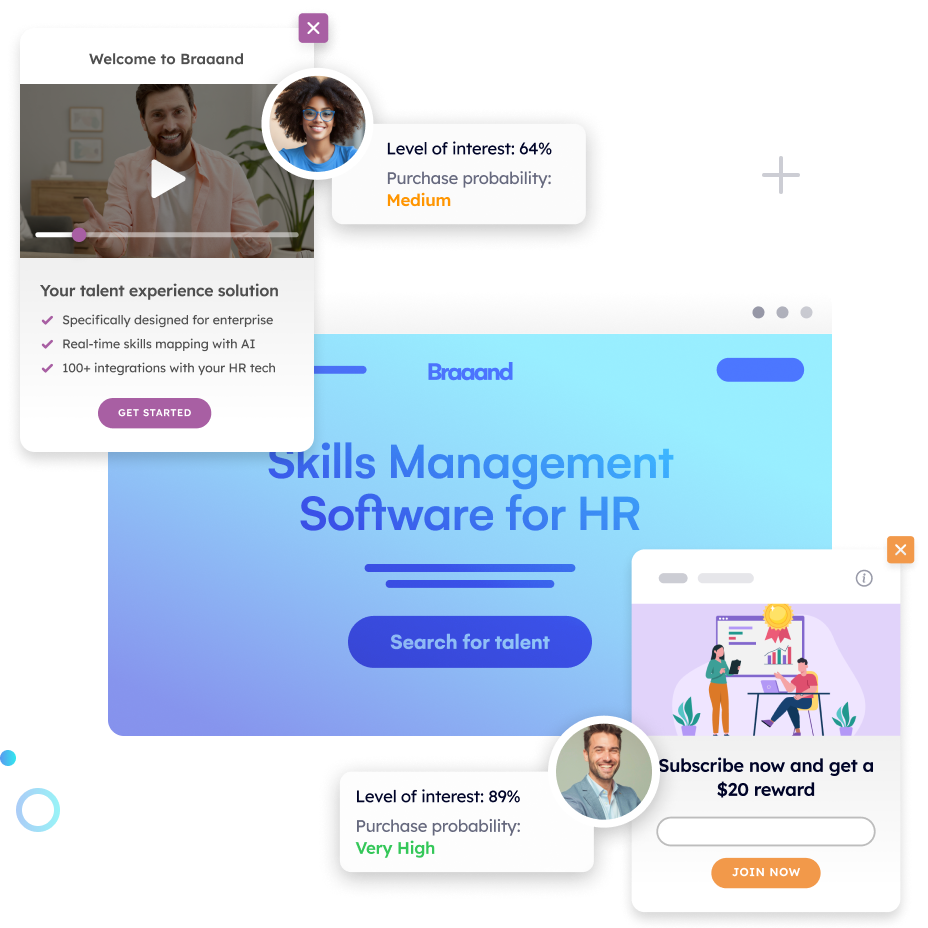
3. Personalization. The core mechanism is buying-stage classification. Pathmonk’s AI analyzes behavioral signals across every session (pages visited, time on page, navigation patterns, scroll behavior, return frequency) and assigns each visitor to one of three stages: Awareness, Consideration, or Decision. Stage classification updates in real time as the session develops and persists across visits. Based on this, Pathmonk triggers stage-appropriate microexperiences automatically: a visitor in Awareness gets a content offer or educational prompt; a visitor in Decision who has returned twice to the pricing page gets a friction-reduced demo path with role-specific social proof. Leveraging social proof at the right journey stage is one of many microexperience decisions the AI handles without manual configuration.
The difference from firmographic personalization is structural. Firmographic systems serve a fixed content variant to everyone who matches a company profile. Pathmonk adapts to where each individual visitor is in their buying journey, which changes across sessions and cannot be inferred from company data alone.
4. Experimentation. Pathmonk’s built-in A/B testing runs microexperience variants side by side from a 50/50 traffic split against a permanent 5% control group. Once the customer feels confident in the results, they manually scale the winning variant to 95% of traffic exposure. Pathmonk does not automatically shift traffic based on interim data, which matters in B2B SaaS where buying cycles are long enough that premature optimization acts on noise rather than signal. The statistical methodology behind uplift measurement is fully documented. One deliberate constraint: Pathmonk only varies the supporting content of a microexperience (social proof, copy framing, offer shown), never the conversion CTA itself. The goal remains identical across all variants, which means test results are always attributable to a single variable.
5. Lead capture and qualification. Pathmonk’s qualification flows replace generic forms with guided multi-step experiences that adapt based on visitor answers, reduce choice overload, and route leads to the right outcome (redirect, form submission, or calendar booking) based on their responses. Web funnels turn passive content pages into interactive qualification sequences. Because Pathmonk already knows each visitor’s buying stage by the time they reach a conversion point, the qualification experience can be calibrated to match: a Decision-stage visitor does not need a five-step educational flow. Best practices for creating high-converting microexperiences covers how to structure the lead capture layer for maximum conversion rate.
The compounding advantage is integration. In a traditional five-tool stack, each layer captures data in isolation. Pathmonk runs all five from the same behavioral data model, which means the analytics inform the personalization, the personalization informs the experimentation, and the experimentation informs the qualification flow. No ETL pipeline, no attribution reconciliation, no discrepancy between what the session tool recorded and what the CRM received. How to optimize your SaaS marketing funnel with AI covers the full architecture for teams building this out.
Increase +180% conversions from your website with AI
Get more conversions from your existing traffic by delivering personalized experiences in real time.
- Adapt your website to each visitor’s intent automatically
- Increase conversions without redesigns or dev work
- Turn anonymous traffic into revenue at scale
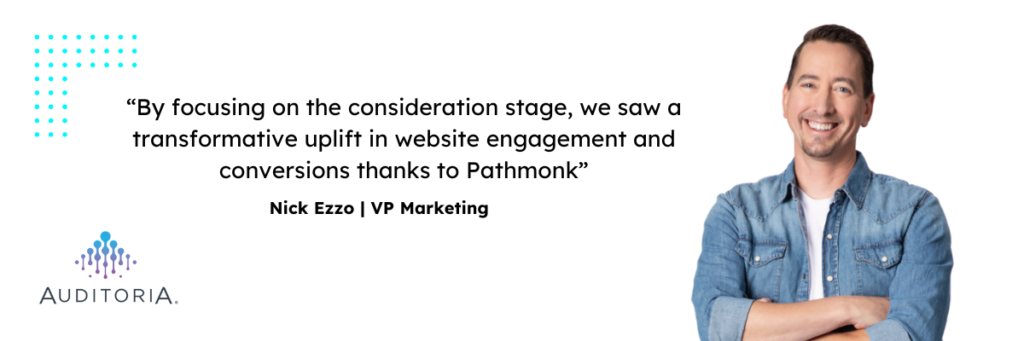
How B2B SaaS Auditoria increased x3 conversion rate with behavioral intent targeting
Auditoria is a B2B SaaS company providing AI-powered finance automation for mid-market and enterprise accounting teams. Their conversion challenge was structural: an extended evaluation cycle (typically 45 to 60 days), a buying committee involving CFOs, controllers, and AP managers, and a website that served the same experience to all of them.
The diagnostic phase identified two specific friction points:
- Homepage and product page content was written for finance executives, creating relevance mismatches for practitioner-level visitors who controlled vendor selection research
- A single demo CTA displayed regardless of where a visitor was in their evaluation, presenting a high-commitment ask to visitors still in early research mode
The solution was buying-stage classification that triggered different microexperiences based on behavioral signals. Visitors in early Awareness received content-led experiences with ROI frameworks and category education. Visitors showing Decision-stage signals (repeat visits to the pricing or integrations pages) received streamlined demo paths with role-specific social proof.
Results:
- 300% lift in overall conversion rate
- Improvement sustained across multiple months, ruling out novelty effect
- No increase in paid acquisition spend during the measurement period
The result is notable because it came entirely from improving the match between visitor intent and on-site experience, not from acquiring a different audience. The traffic composition did not change; what changed was the experience delivered to each visitor based on where they were in their buying process.
FAQs on CRO for B2B SaaS
What is the minimum traffic threshold to use A/B testing tools effectively in B2B SaaS?
A practical minimum for statistically reliable results is 500 conversions per variant. At a 2% conversion rate, reaching this threshold requires 25,000 sessions per variant, or roughly 50,000 monthly sessions on the page being tested. Most B2B SaaS companies below $10M ARR do not have this volume on a single page, which makes behavioral targeting and personalization more productive investments than formal A/B experimentation for the majority of their funnel.
Can CRO tools work effectively without a dedicated CRO specialist?
Yes, but the scope of what is actionable shrinks considerably. Session intelligence tools like Hotjar and Clarity are usable by generalist marketers with a few hours of baseline setup. Firmographic personalization platforms require segment strategy, content creation for each variant, and ongoing performance analysis. A realistic ceiling without a specialist is two or three active segments and one experiment running at a time, with at minimum one review per month. Behavioral intent platforms like Pathmonk reduce this overhead because the AI handles stage classification and experience triggering autonomously.
How do intent data tools handle GDPR and international privacy compliance?
Third-party intent platforms that aggregate behavioral data across publisher networks operate in a contested area under GDPR, with most relying on legitimate interest as their legal basis, which is subject to challenge. IP-to-company matching (Clearbit, Leadfeeder) is generally considered lower risk because it identifies a business entity rather than an individual. Tools that identify individuals by name or LinkedIn profile require explicit consent mechanisms in EU/EEA markets and should be reviewed against your privacy counsel’s guidance before deployment.
What is the difference between product analytics tools (Mixpanel, Amplitude) and CRO tools?
Product analytics tools like Mixpanel and Amplitude are designed for tracking behavior inside a product: feature adoption, in-app funnel completion, and retention cohort analysis. CRO tools are designed for the pre-conversion environment: the marketing website, pricing page, and landing pages that convert anonymous traffic into leads or trials. The two categories measure different events in different environments and should not be conflated, though they share data infrastructure (user identity, event taxonomy) that benefits from being designed together.
Which CRO tool category delivers the fastest time-to-value for a new SaaS team?
Session intelligence tools (Hotjar, Clarity) deliver the fastest time-to-value because they require no CRM integration and generate actionable diagnostic insights within two to four weeks of deployment. A typical initial session recording analysis produces two or three concrete hypotheses about conversion friction that would not have been visible from pageview data alone. These are testable within a sprint cycle.
How does CRO stack complexity affect data quality?
Each additional tool adds an implementation dependency: tag management conflicts, data sampling differences, and attribution disagreements between platforms. Teams running more than four CRO tools simultaneously frequently encounter situations where session counts differ between Hotjar and Google Analytics by 15 to 20%, or where A/B test conversion rates diverge from CRM records. The practical recommendation is to standardize on one tool per layer and define the primary conversion event centrally so all tools measure the same thing.
When should B2B SaaS companies prioritize personalization over A/B testing?
When traffic volume falls below the threshold for statistically reliable experiments (see above), personalization produces faster returns because it does not require a holdout period or significance calculation. Personalization based on deterministic signals (company size from IP identification, returning visitor status, time since first visit) carries lower statistical risk than inference from small sample sizes and can be deployed, iterated, and measured on a faster cycle than formal experiments.
Does CRO tooling change when moving from PLG to sales-led growth?
Yes, substantially. Product-led growth motions prioritize trial activation and in-product onboarding; the most relevant CRO tools are product analytics (Amplitude, Mixpanel) and in-app experience platforms (Appcues, Pendo). Converting SaaS free trial users to paying customers is a separate optimization problem from converting anonymous website visitors. Sales-led motions prioritize demo conversion and lead quality; the tools that matter are intent identification, pipeline-focused chat, and meeting booking automation. Hybrid PLG/SLG motions need both stacks and require explicit ownership decisions about which team manages which conversion event to avoid measurement fragmentation.
Grow your SaaS pipeline with personalized interactions
- Qualify visitors before they ever reach your sales team
- Increase demos booked from existing traffic
- Guide buyers with intent-based product experiences
Key takeaways
- B2B SaaS CRO differs from e-commerce CRO in three structural ways: longer cycles require multi-session identity persistence, lower traffic limits A/B test velocity, and company firmographics change the relevance of every page element
- The Conversion Signal Stack organizes CRO tools into five functional layers: session intelligence, intent identification, personalization, experimentation, and lead capture
- Session intelligence tools are diagnostic; they identify where friction exists but not why it exists, and require pairing with qualitative research to produce testable hypotheses
- Intent and company identification is the highest-leverage and most underinvested layer for most B2B SaaS marketing teams
- A/B testing requires a minimum of 500 conversions per variant for reliable results; teams below 50,000 monthly sessions on tested pages should prioritize behavioral targeting over formal experimentation
- Personalization produces the highest lift when the friction source is relevance mismatch between visitor intent and page content, not UX or performance issues
- Lead capture tools that route based on on-site behavioral signals consistently produce better SQL rates than those routing by self-reported form fields alone
- Stack complexity beyond four tools introduces data quality problems that erode the reliability of conversion metrics across the board
- Pathmonk compresses intent classification, personalization, and experimentation into a single implementation by triggering stage-appropriate microexperiences based on real-time buying journey position, without modifying the conversion goal itself